 Phone:



A-SAFE People and Traffic Protection
A-SAFE Safety Barriers
A-SAFE safety barriers are flexible polymer systems that physically separate pedestrians from forklifts and protect racking, buildings and equipment from vehicle impact. They are tested to PAS 13 methods with results verified by TÜV NORD. DMD Warehouse Solutions supplies, lays out, installs and supports A-SAFE barriers across Western Australia.
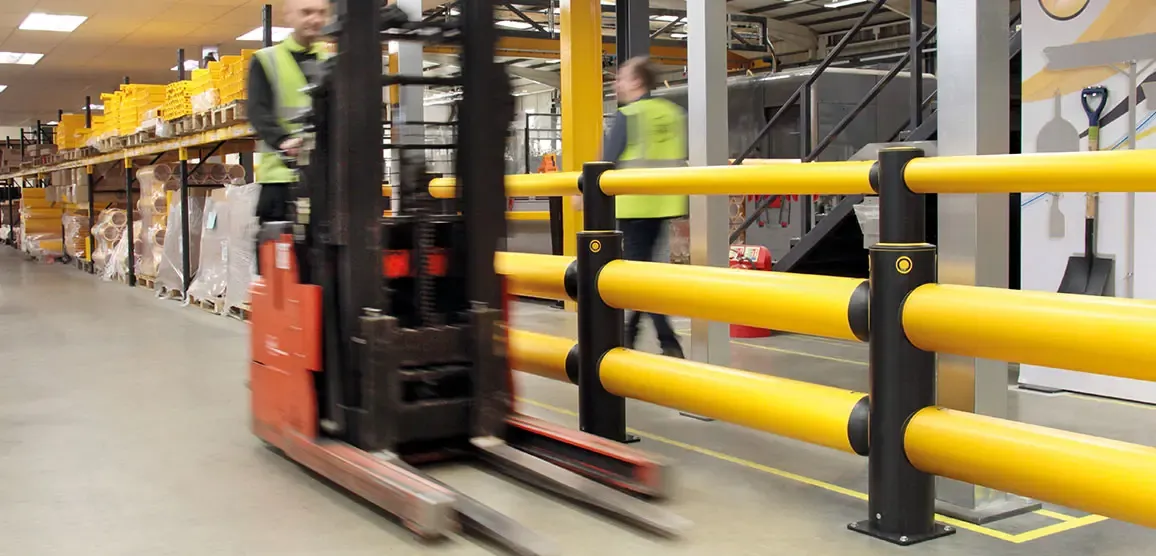


6 Core iFlex Systems
Traffic, Traffic+, pedestrian, gates and bollards.

PAS 13 Tested
Impact tested to recognised workplace barrier methods.

TÜV NORD Verified
Independent verification of A-SAFE test results.

WA Install and Support
Layout, installation and local service from DMD.
Watch the Barrier Work
It flexes, absorbs the impact and returns towards its shape.
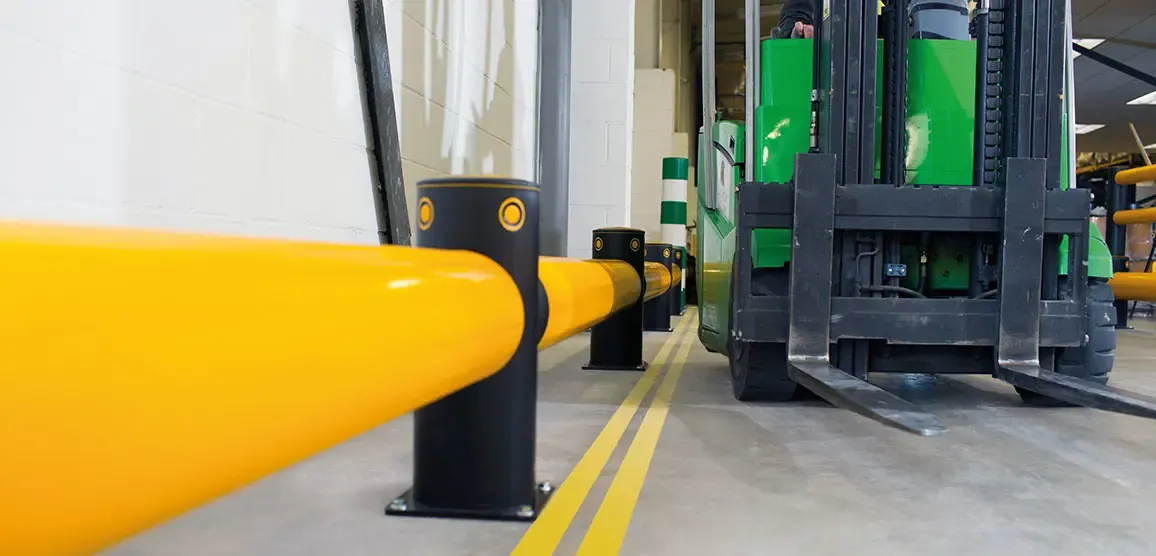
A-SAFE test footage shows the difference between polymer and rigid steel. The Memaplex rail flexes and the coupling system absorbs energy in stages, so less of the impact is passed as a rigid shock into the vehicle, the anchors and the concrete floor.
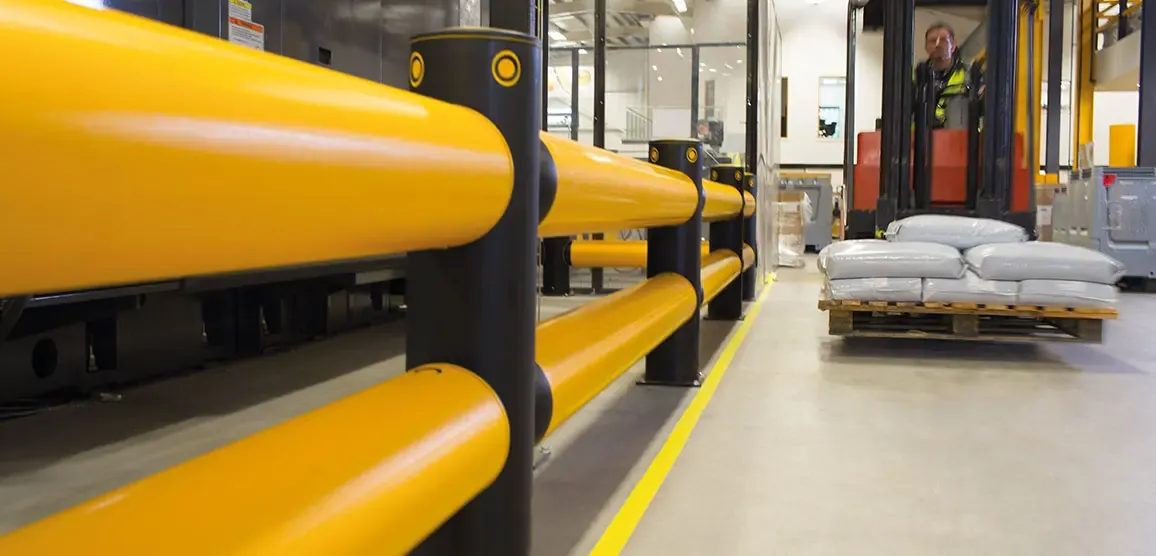
Single and Double Traffic
Protection matched to the vehicle.
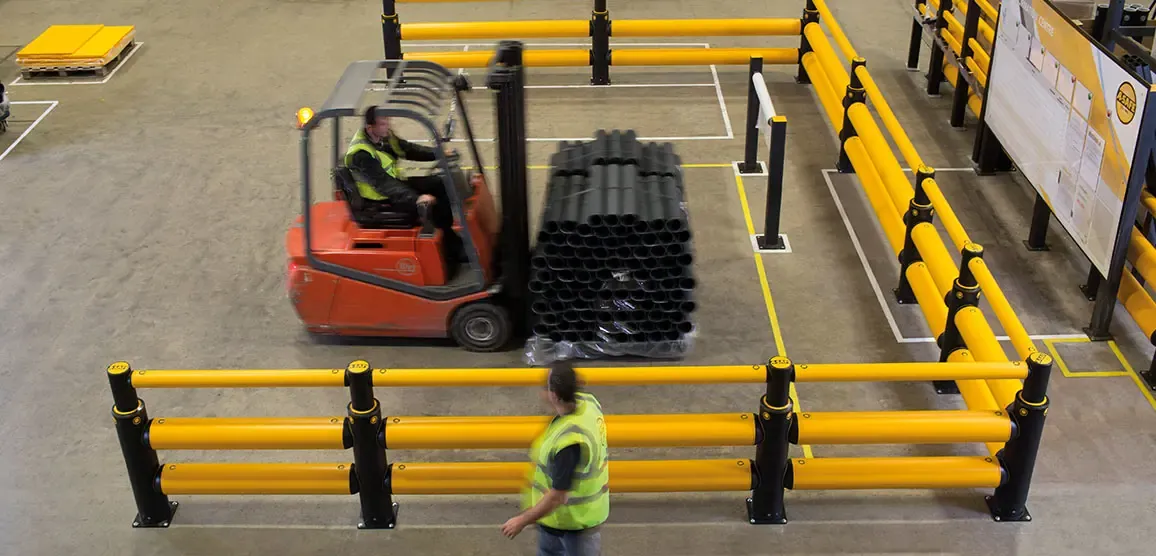
Traffic barriers protect machinery, walls, doors and infrastructure from vehicle impact. The iFlex Single Traffic Barrier uses one impact rail for lower impact heights. The Double Traffic Barrier adds a second rail across a taller impact zone for heavier vehicles and higher-risk areas. DMD selects the system from the real vehicle mass, speed, angle and impact height at each location.
15,100 J
Single Traffic rating (A-SAFE)
20,500 J
Double Traffic rating (A-SAFE)
Single rail: 205 to 395 mm impact zone
Double rail: 205 to 745 mm impact zone
Yellow, black or grey as standard
Double rail: 205 to 745 mm impact zone
Yellow, black or grey as standard
Single and Double Traffic+
Painted lines ask. Barriers separate.
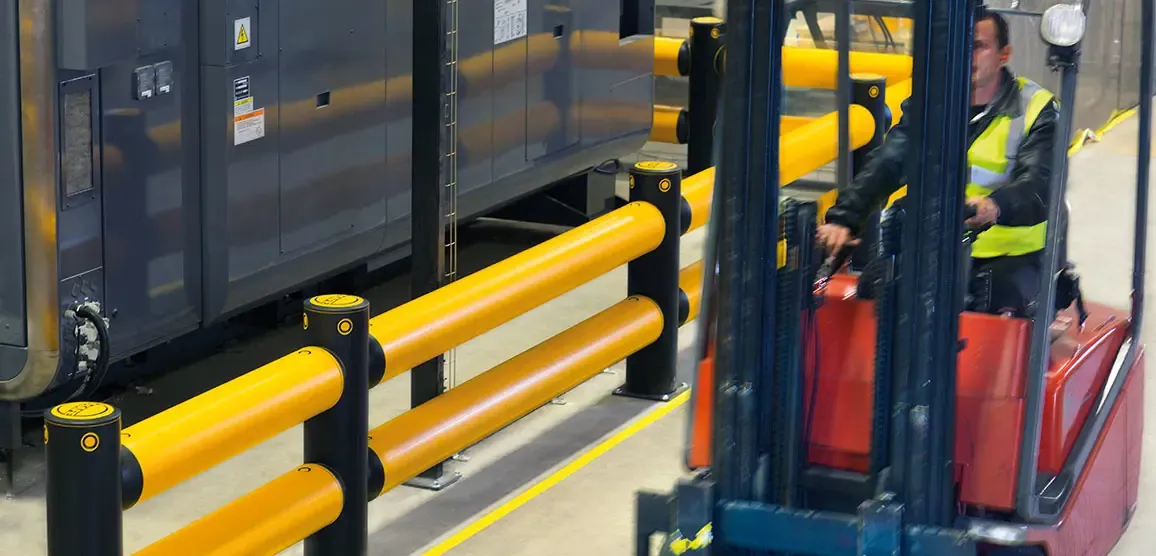
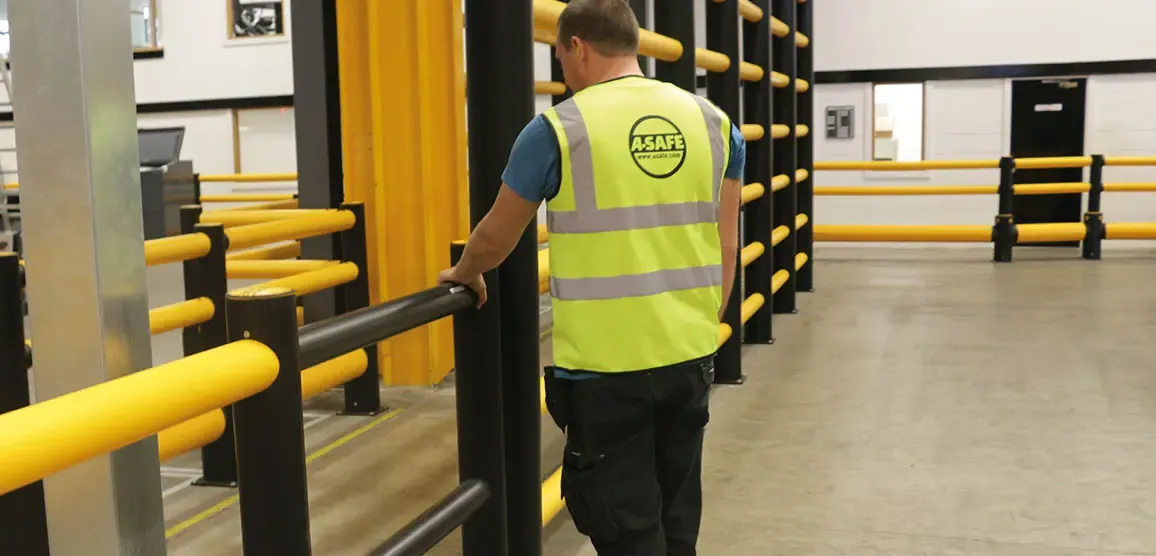
Traffic+ barriers add an ergonomic handrail to the traffic rails, so one barrier stops the vehicle and guides the pedestrian. The Single Traffic Barrier+ suits walkways beside medium-weight vehicles. The Double Traffic Barrier+ is the strongest people-and-asset barrier in the core iFlex range, with two impact rails for walkways beside heavyweight vehicles in busy areas.
15,100 J
Single Traffic+ rating (A-SAFE)
20,500 J
Double Traffic+ rating (A-SAFE)
Impact rail plus integrated handrail
Physical separation of people and vehicles
Gates fit at every crossing point
Physical separation of people and vehicles
Gates fit at every crossing point
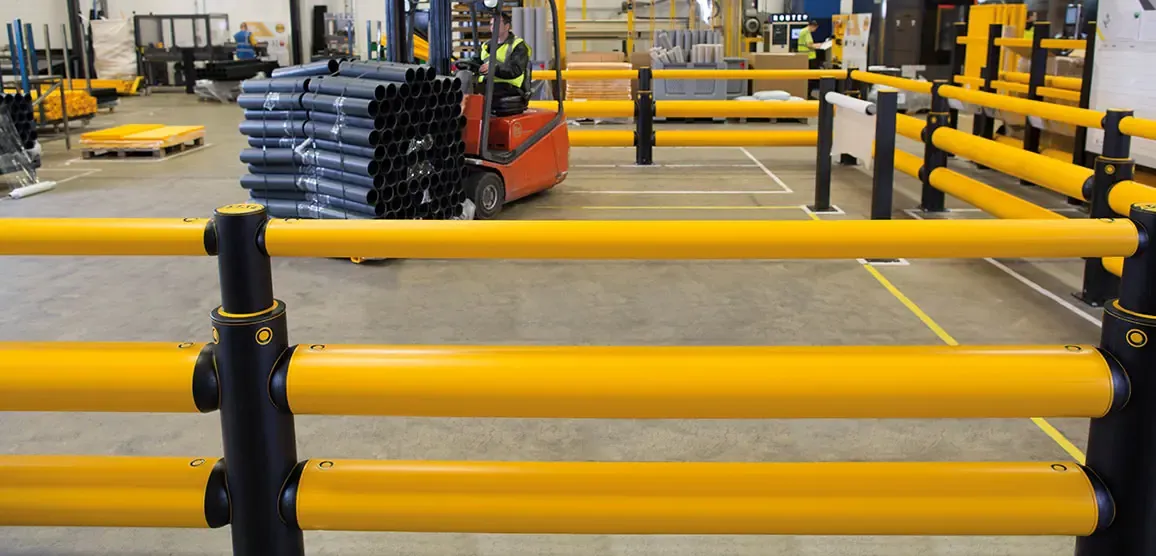
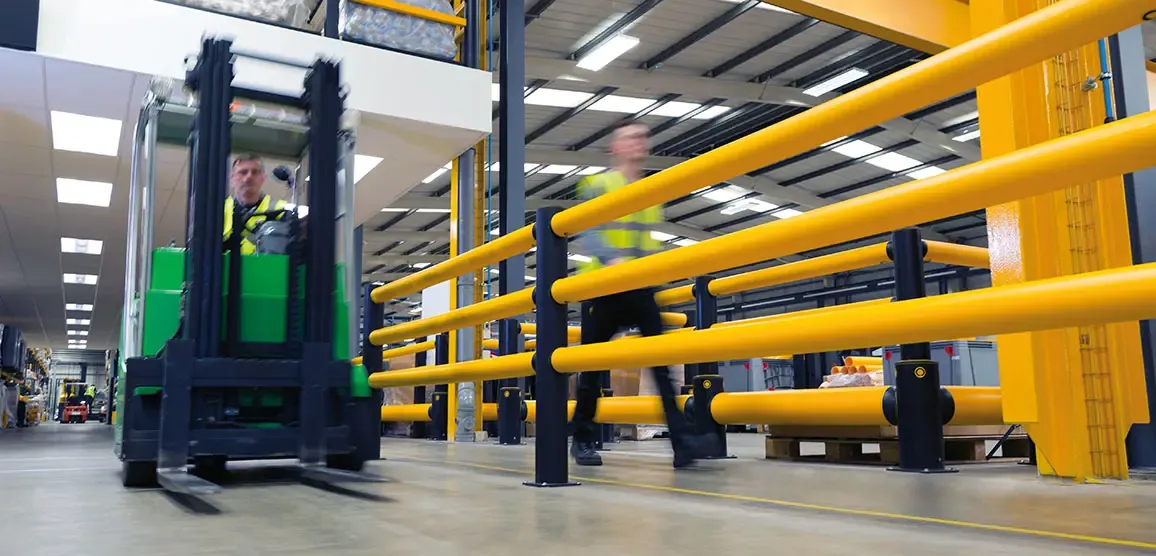
Pedestrian 3 Rail
The standard walkway barrier.
The iFlex Pedestrian 3 Rail is A-SAFE’s standard pedestrian barrier. Three 100 mm polymer rails give a full-height, highly visible boundary that keeps people on a defined route and cushions and deflects impact forces if a vehicle strays. It suits walkways beside lightweight vehicles or where shallow-angle impacts are the main risk.
5,800 J
Pedestrian 3 Rail rating (A-SAFE)
450 to 1,100 mm
Impact zone
Three rails define walkways at full height
Indoor and outdoor use, in many lengths
Step up to Traffic+ beside heavier forklifts
Indoor and outdoor use, in many lengths
Step up to Traffic+ beside heavier forklifts
Bollards and Gates
Hotspots covered. Crossings controlled.
iFlex Bollards guard corners, doorways, columns and equipment where vehicles must be kept out but people still need to pass. A barrier run is only as safe as its openings, so iFlex Swing Gates use a hydraulic self-close and can be set to open one way, making pedestrians stop and check before crossing. Slide Gates open telescopically for vehicle entry.
5,800 J
iFlex Bollard rating (A-SAFE)
0 to 1,200 mm
Bollard impact zone
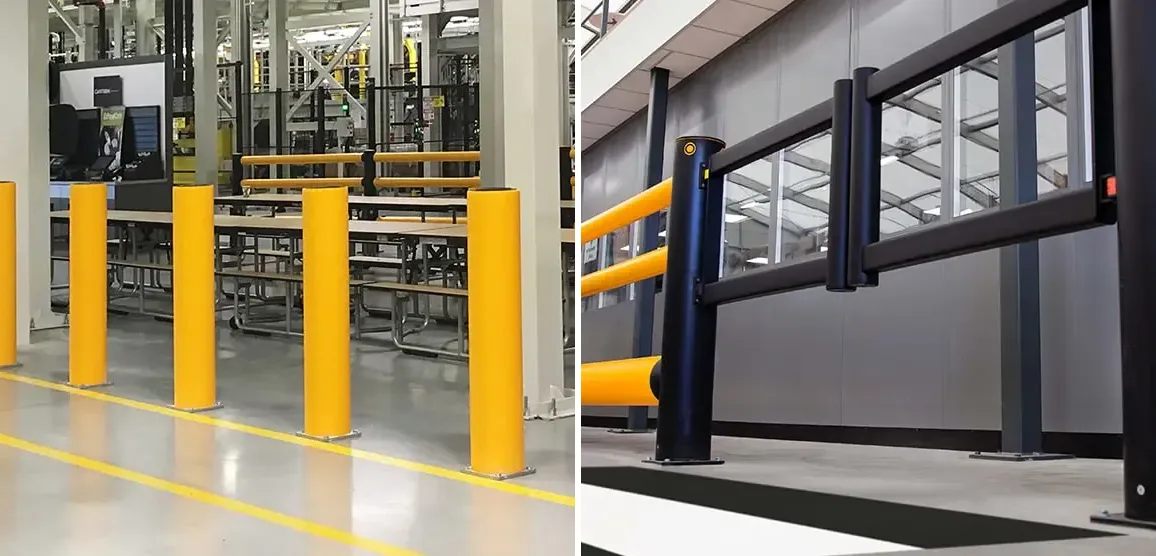
Bollards for isolated hotspots
Self-closing short and long swing gates
Space-saving slide gates
Self-closing short and long swing gates
Space-saving slide gates
Business Case
Capabilities
Specifications
DMD Deployment
Physical Separation Where It Matters
Forklift and pedestrian interaction is one of the main traffic risks on an industrial site, and impact damage to racking, doors and walls adds steady repair costs. A-SAFE barriers deal with both: they physically separate people from vehicles and absorb impacts that would otherwise damage assets and floors.
THE PROBLEM
People walk beside forklifts
Painted lines and signs depend on every driver and pedestrian.
A-SAFE OUTCOME
Traffic+ and Pedestrian barriers create a physical boundary.
THE PROBLEM
Crossings lose control
Gaps in a barrier run let people step out without looking.
A-SAFE OUTCOME
Self-closing swing gates make every crossing deliberate.
THE PROBLEM
Steel barriers damage the slab
Rigid barriers pass impact loads into anchors and concrete.
A-SAFE OUTCOME
Polymer rails flex and absorb energy before it reaches the floor.
THE PROBLEM
Repairs mean replacing whole runs
Bent steel often has to be cut out and replaced.
A-SAFE OUTCOME
Modular rails and posts are replaced individually.
Where A-SAFE Fits
Warehousing and distribution
Manufacturing
Mining support facilities
Food and beverage
Cold storage
Workshops and maintenance
Transport and logistics
Service yards and docks
Know What It Is Rated To
A-SAFE tests its barriers using PAS 13 methods, with results verified by TÜV NORD and stated against vehicle mass, speed and impact angle. DMD uses these ratings to match each location to the right system, and checks slab condition and fixings before installation. Not every yellow barrier is equal: the right system depends on the actual vehicle and the consequence at each location.
The Six Core iFlex Systems
Single Traffic Barrier
Single impact rail that protects machinery, walls and infrastructure. 15,100 J.
Single Traffic Barrier+
Impact rail plus an ergonomic handrail to separate and guide pedestrians. 15,100 J.
Double Traffic Barrier
Twin rails across a taller impact zone for heavyweight vehicles. 20,500 J.
Double Traffic Barrier+
Twin impact rails plus handrail for people beside heavy vehicles. 20,500 J.
Pedestrian 3 Rail
The standard walkway barrier: three 100 mm rails at full height, 450 to 1,100 mm impact zone. 5,800 J.
iFlex Bollards
Highly visible protection for corners, doorways and equipment. 5,800 J.
Gates and Access
Swing Gate Short
Hydraulic self-close and double swing action, with gate stops to set one-way opening.
Swing Gate Long
The same self-closing action for wider pedestrian openings.
Slide Gate
Telescopic sliding motion for vehicle entry and exit where space is tight.
Fits Every Run
Gates are compatible with all A-SAFE guardrails; slide gates can be paired for wider openings.
The Wider A-SAFE Range
Rack Protection
RackGuard, RackEnd barriers and RackEye racking monitoring.
Topple Barriers
High-level protection from falling or leaning stacked goods.
Height Protection
Height restrictors to protect doors, overhead services and structures.
Dock Safety
Dock gates, dock buffers and protection for loading areas.
Kerb Protection
ForkGuard and low-level protection from forks and pallet trucks.
Cold Storage
Barrier variants purpose-engineered for sub-zero environments.
A-SAFE BARRIER SPECIFICATION
Single Traffic
15,100 J; 205 to 395 mm zone
Single Traffic+
15,100 J plus handrail
Double Traffic
20,500 J; 205 to 745 mm zone
Double Traffic+
20,500 J plus handrail
Pedestrian 3 Rail
5,800 J; 450 to 1,100 mm zone
iFlex Bollard
5,800 J; 0 to 1,200 mm zone
Traffic rail
190 mm diameter
Pedestrian rail
100 mm diameter
Impact testing
PAS 13 methods
Verification
TÜV NORD
Standard colours
Yellow, black or grey
Swing gates
Hydraulic self-close
Ratings are A-SAFE’s published example vehicle energies for a 90° impact. Final selection depends on vehicle mass, speed, approach angle, impact height, post spacing, slab condition and fixings, which DMD confirms on site. Last updated October 2026.
DMD SUPPLIES AND INSTALLS A-SAFE IN WA
DMD turns the A-SAFE range into a site-ready layout around your real vehicle movements, assets and access needs.
1
Site Review
Map pedestrian routes, vehicle interactions, impact hotspots and access points.
2
System Selection
Match products to vehicle mass, speed, impact height, angle and consequence.
3
Layout and Proposal
A clear barrier plan, product schedule and scope that suits daily operations.
4
Installation
Delivery and installation of the approved system with minimal disruption.
5
Local Support
Inspections, replacement parts, changes and extensions as the site grows.
Make the Risk Visible
Show DMD where people, vehicles and assets meet.
Send us your site layout, the vehicles you run and the areas that worry you. We will walk the site, map the interaction points and turn them into a practical A-SAFE barrier plan and product schedule.
Phone: 08 9410 9400
Email: [email protected]
common questions
A-SAFE Barriers
K
L
What is the difference between Traffic and Traffic+ barriers?
Traffic barriers protect assets, buildings and equipment from vehicle impact. Traffic+ adds an integrated handrail, so the same barrier also separates and guides pedestrians. Choose Traffic+ wherever people walk beside the protected route.
K
L
When should we use Single Traffic or Double Traffic?
It depends on vehicle mass, speed, impact height, angle and consequence. A-SAFE rates the iFlex Single Traffic Barrier at 15,100 J across a 205 to 395 mm impact zone and the Double Traffic at 20,500 J across a taller zone, so Double is used for heavier vehicles and higher-risk areas.
K
L
When is the Pedestrian 3 Rail barrier the right choice?
Use the iFlex Pedestrian 3 Rail for walkways and work areas beside lightweight vehicles, or where impacts are likely to be at shallow angles. A-SAFE rates it at 5,800 J across a 450 to 1,100 mm impact zone. Where heavier forklifts run beside the walkway, a Traffic+ barrier is the better choice.
K
L
How does A-SAFE help protect the concrete floor?
The polymer rails flex and absorb impact energy instead of acting like a rigid steel lever, which reduces the peak force passed through the base plates and anchors into the slab. DMD still checks slab condition, thickness, edge distances and fixings for each site.
K
L
How are A-SAFE barriers tested?
A-SAFE tests its industrial safety barriers using PAS 13 methods, the British code of practice for workplace safety barriers, and TÜV NORD independently verifies the test results. Ratings are stated against vehicle mass, speed and impact angle.
K
L
Can DMD design a full pedestrian and vehicle segregation layout?
Yes. DMD reviews your traffic routes, pedestrian movements, impact hotspots and access needs, then develops a barrier layout and product schedule that works with daily operations.
K
L
Who supplies and installs A-SAFE barriers in Western Australia?
DMD Warehouse Solutions, based in Bibra Lake, supplies, lays out, installs and supports A-SAFE barrier systems across Perth and Western Australia, including inspections, replacement parts and extensions.
Warehouse Efficiency Audit
Find the Impact Hotspots
Talk to DMD’s WA safety team
A-SAFE Barriers
Speak To Us About Your Project
Bring your site layout